How Much Protein In A Pork Chop
A practical step-by-step guide to how much protein in a pork chop, including preparation, instructions, common issues, tips, and next steps.
How Much Protein In A Pork Chop
A pork chop can be an excellent source of high-quality protein, but the exact amount varies significantly based on the cut, size, and cooking method. This guide provides a clear, step-by-step process to help you accurately determine how much protein is in the specific pork chop on your plate. Whether you're tracking macronutrients for fitness goals, managing your diet, or simply curious about your food, these instructions will replace guesswork with precise data.
Fast Answer
- Average Protein: 22-26 grams per 100g (3.5 oz) of cooked, boneless pork chop.
- Key Factors: The cut (loin is leaner), bone-in vs. boneless, and cooking method all change the final protein value.
- Most Accurate Tool: A digital food scale combined with the USDA FoodData Central database.
Before You Start
To get an accurate protein count, you need to do more than just a quick online search. A generic answer won't account for your specific meal. Gathering these simple tools and pieces of information beforehand will make the process fast and reliable.
- Digital Food Scale: This is the most critical tool for accuracy. Guessing portion size is a common source of error in nutrition tracking.
- Your Pork Chop: Have the pork chop ready for inspection and weighing, preferably before you cook it.
- Internet Access: You'll need to access a reliable online nutrition database to look up the final numbers.
- Basic Information: Try to know the cut of your pork chop (e.g., loin, rib, sirloin). If you bought it from a butcher, the label should specify this.
Step-by-Step Instructions
Identify the Cut of Your Pork Chop
Not all pork chops are created equal. The part of the pig it comes from determines its leanness and, therefore, its protein density. A leaner cut has more protein and less fat per ounce.
- Loin Chop (or Center-Cut Chop): This is one of the most common and leanest cuts. It looks like a small T-bone steak and has a very high protein-to-fat ratio. This is often the best choice for maximizing protein intake.
- Rib Chop (or Ribeye Chop): Coming from the rib section, this cut has a bit more fat and is very tender. Its protein content is slightly lower than a loin chop due to the higher fat content.
- Sirloin Chop: This cut comes from near the pig's hip and contains various muscle groups and bone. It can be flavorful but is generally tougher and has a more variable fat content.
- Blade Chop (or Shoulder Chop): From the shoulder area, this cut is known for being rich in flavor due to its higher fat marbling. It has the lowest protein density of the common cuts.
If your packaging doesn't specify the cut, a lean, pale piece of meat with minimal visible fat is likely a loin chop. A darker, more marbled piece is probably a blade or rib chop.
Determine if Your Chop is Bone-In or Boneless
This is a simple but crucial distinction. Nutrition labels and database entries are for the edible portion of the food. The bone contains no protein you can eat, so its weight must be excluded from your calculation. If you have a bone-in chop, you are starting with less edible meat than a boneless chop of the same total weight.
For now, just make a note of whether your chop has a bone. We will account for its weight in a later step. A boneless loin chop is the most straightforward for calculations, as the weight on the scale is the weight you will use.
Weigh the Pork Chop Accurately
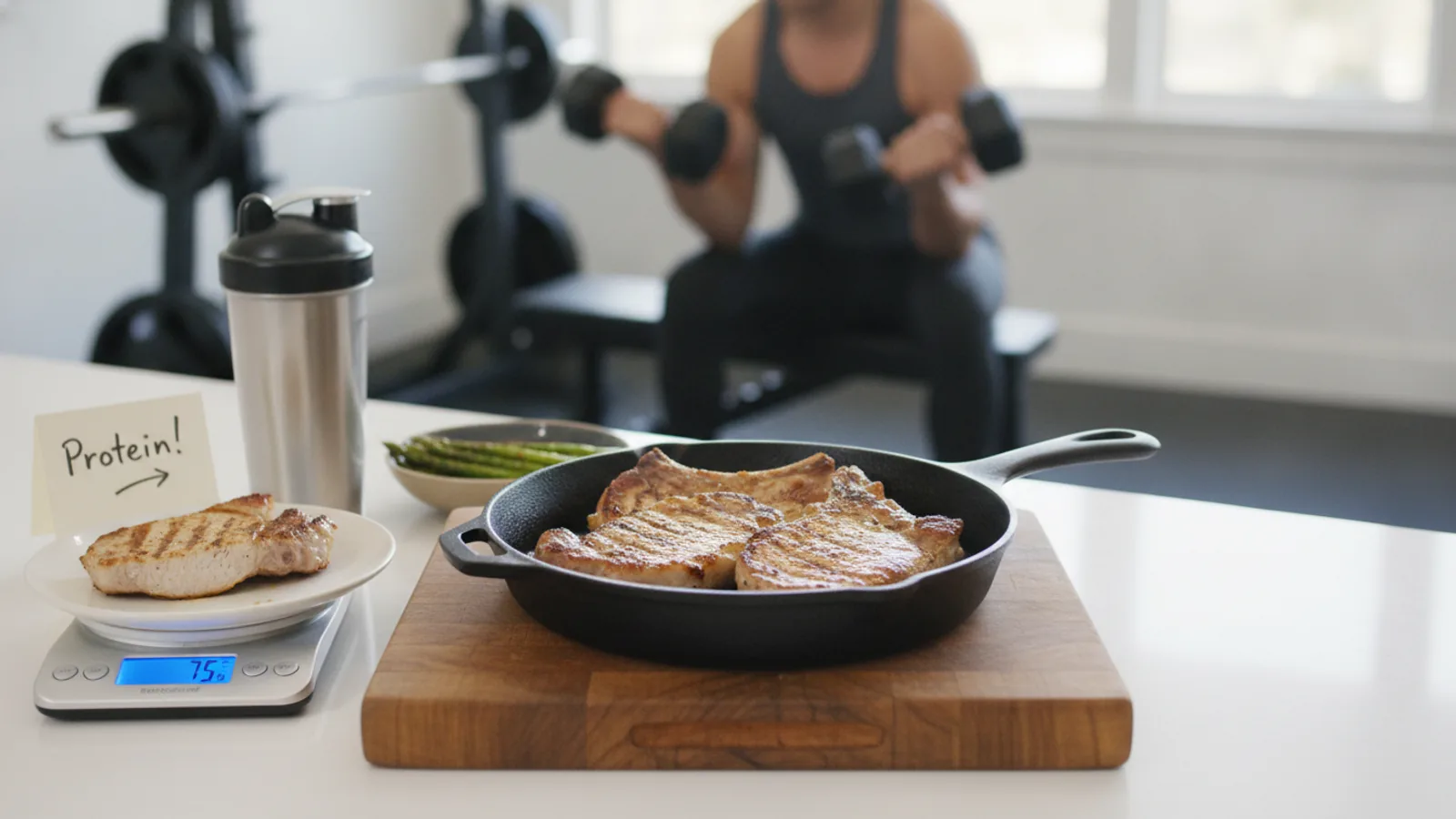
Place your digital food scale on a flat surface and turn it on. Make sure it is set to zero (tare). Place the pork chop directly on the scale. It's best practice to weigh your meat in grams for the most precise calculations, as most scientific databases use grams.
You have two primary options for when to weigh:
- Weighing Raw: This is easy to do before cooking. Record the raw weight. The challenge is that you must then find a database entry for "raw" pork chop of your specific cut. This method is less accurate for determining what you actually consumed, as you don't know the final cooked weight.
- Weighing Cooked: This is the recommended method for accuracy. Cook the pork chop as desired. Let it rest for a few minutes, then place the entire cooked portion on the scale and record the weight. This number represents the food you are about to eat, making the final protein calculation more precise.
Account for the Bone's Weight
If you have a bone-in pork chop, you must subtract the weight of the bone to find the true weight of the meat you're eating. You can't do this perfectly before you eat, but you have a couple of solid options.
- The Estimate Method: For a quick calculation, you can assume the bone makes up about 20-30% of the total weight of a bone-in chop. If your cooked, bone-in chop weighs 200g, you could estimate the edible portion to be about 140-160g. This is good for a general idea.
- The Most Accurate Method: Weigh the entire cooked pork chop. Eat the meat off the bone. Then, place the clean bone (and any bits of gristle you didn't eat) back on the scale. Subtract the bone's weight from the total cooked weight you recorded earlier. The result is the exact weight of your edible portion.
Use a Reliable Nutrition Database
General search engines or fitness apps can have inaccurate, user-submitted data. For dependable information, go to the source. The best resource for US residents is the USDA FoodData Central. It's a free, comprehensive database maintained by the U.S. Department of Agriculture.
Navigate to the FoodData Central website. In the search bar, type a specific description of your food. The key is to be as detailed as possible. For example, instead of "pork chop," search for:
"Pork, fresh, loin, top loin (chops), boneless, separable lean only, cooked, pan-fried"
Match your search query to your pork chop's cut, state (cooked), and cooking method. The database will provide a detailed nutritional breakdown, usually per 100 grams.
Calculate the Final Protein Amount
Once you have the nutritional information, the final step is simple math. The database will show you the protein content per 100g. You just need to apply that to the weight of your specific portion.
Let's walk through an example:
- You found a database entry for your cooked loin chop that lists 26g of protein per 100g.
- Your cooked, boneless portion of meat on the scale weighs 180g.
First, find the amount of protein per gram:
26g protein / 100g = 0.26g of protein per gram of meat.
Next, multiply this by your portion's weight:
0.26g protein/gram * 180g portion = 46.8g of protein.
So, your 180g serving of cooked pork chop contains approximately 47 grams of protein. You can use this same formula for any food and any nutrient you want to track.
Quick Reference
| Situation | Use This Method | Why |
|---|---|---|
| Maximum Accuracy (Bone-In) | Weigh the whole chop after cooking. Eat. Weigh the bone. Subtract bone weight from total. Use the resulting "edible weight" with a "cooked" database entry. | This removes all guesswork about portion size and accounts for moisture loss, giving you the most precise protein count for what you consumed. |
| Quick & Easy (Boneless) | Weigh the boneless chop after cooking. Look up a "cooked, boneless" entry for your cut and calculate the protein based on that weight. | This is fast and very accurate for boneless cuts, as there's no need to account for bone weight. |
| No Food Scale Available | Use your hand for a rough estimate. A portion of meat the size of your palm or a deck of cards is about 3 ounces (85g). Find a generic entry for a cooked pork chop and use that value. | This is the least accurate method but is much better than not tracking at all. It provides a reasonable estimate for casual tracking. |
Common Problems When Calculating Pork Chop Protein
Even with a clear process, a few common issues can trip you up. Here’s how to solve them.
- Problem: The database has too many options and I don't know which one to choose.
Solution: When in doubt, choose a more generic entry. Searching for "pork chop, loin, cooked" is better than getting paralyzed by choices like "pan-fried" vs. "broiled." The difference is usually minor. Also, look for entries from sources like "USDA" or "Branded Food Products" for reliability. - Problem: My fitness app gives me a completely different number.
Solution: Many fitness apps rely on user-submitted data which can be inaccurate or incomplete. They often use averages that don't account for your specific cut or cooking method. Trust the USDA database first. If your app allows, you can create a custom food entry using the data from FoodData Central for future use. - Problem: I forgot to weigh my pork chop before I ate it.
Solution: Don't worry, you can still get a good estimate. If you have another, similar-sized raw pork chop from the same package, weigh that one and use it as a close approximation. Otherwise, use a visual guide (like the deck-of-cards method) to estimate the portion size you ate and accept that it will be a rough estimate this time.
Advanced Tips for Protein Tracking
Once you've mastered the basics, these tips can help you be even more efficient and precise.
- Factor in Marinades and Breading: If you cook your pork chop with a sugary BBQ sauce, breading, or an oily marinade, these additions add calories (mostly from carbs and fats) but not protein. For strict tracking, you should weigh or measure these ingredients separately. A simple salt, pepper, and herb rub will not meaningfully change the macros.
- Batch Cooking for Meal Prep: If you're cooking several pork chops at once, cook them all, remove the bones (if any), and weigh the total amount of edible meat. Divide this total weight by the number of meals you're prepping. This gives you a very accurate average weight per meal, saving you from weighing each portion individually.
- Trim the Fat for Higher Protein Density: The protein is in the muscle, not the fat. If you want to increase the protein-to-calorie ratio, trim the thick cap of fat from the edge of your pork chop before cooking. Weigh your portion after trimming to get a more accurate reading of the lean meat you're consuming.
How Much Protein In A Pork Chop FAQ
How much protein is in a 6 oz pork chop?
This depends entirely on whether it's raw or cooked, and bone-in or boneless. A typical cooked, boneless 6 oz (170g) pork loin chop will have approximately 44-50 grams of protein. A 6 oz raw, bone-in chop will have significantly less edible meat and therefore a lower final protein count after cooking and deboning.
Does the cooking method change the protein content?
Yes, but primarily by changing the weight. Cooking removes water, which concentrates the protein in the final product. A 100g serving of cooked pork has more protein than 100g of raw pork because it's denser. The total amount of protein in the entire pork chop from start to finish remains almost the same, though very high, prolonged heat can slightly degrade some amino acids.
Is pork chop a good source of protein for building muscle?
Absolutely. Pork is a "complete protein," meaning it contains all nine essential amino acids that your body cannot produce on its own. These amino acids are the building blocks of muscle tissue, making pork chops an excellent food for muscle repair and growth, similar to chicken breast, beef, and fish.
Which cut of pork chop has the most protein?
The center-cut loin chop typically has the most protein per gram. It is the leanest common cut, meaning more of its weight is protein-rich muscle tissue and less is fat. Blade or shoulder chops, with their generous marbling, will have a lower protein content.
How does a pork chop compare to a chicken breast for protein?
They are very comparable and both are fantastic protein sources. A skinless chicken breast is generally slightly leaner than even a lean pork chop, so it often has a little more protein per gram. For example, 100g of cooked chicken breast has about 31g of protein, while 100g of cooked pork loin has about 26g. The difference is small enough that both can easily fit into a high-protein diet.
Final Checklist for Finding Pork Chop Protein
Before you log your meal, run through this quick checklist to ensure you've got the most accurate number possible.
- Identified the specific cut of pork (e.g., loin, rib).
- Used a digital food scale for weighing, not guessing.
- Weighed the meat in its cooked state for best results.
- Subtracted the weight of the bone from the total.
- Used a reputable database like USDA FoodData Central.
- Matched the database entry to your cut and cooking method.
- Performed the final calculation based on your exact portion weight.
What should I check before acting on advice about how much protein in a pork chop?
Use this guide as a starting point, compare current specifications and costs, and check the details that apply to your own situation before making a purchase or booking.
Where can I find related nutrition guidance?
Browse the related guides in this section for practical comparisons, planning notes, and next steps that support the same decision.