How Much Protein In A Rotisserie Chicken
A practical step-by-step guide to how much protein in a rotisserie chicken, including preparation, instructions, common issues, tips, and next steps.
How Much Protein In A Rotisserie Chicken
Rotisserie chicken is a convenient and affordable source of high-quality protein, crucial for muscle building, repair, and overall health. This guide provides a clear, step-by-step method to accurately determine how much protein is in your store-bought chicken, whether you're using the nutrition label or calculating it yourself. We'll cover everything from weighing portions and understanding the difference between white and dark meat to accounting for skin and high sodium levels, helping you fit this popular meal into your specific fitness and dietary goals.
Fast Answer
- Total Protein (Avg. Chicken): ~140-160 grams
- Breast Meat (3 oz / 85g): ~26 grams protein
- Thigh Meat (3 oz / 85g): ~22 grams protein
Before You Start
- Digital food scale: This is essential for accuracy. Guesstimating portion sizes is the most common source of error in tracking macros.
- Carving knife and fork: For safely and efficiently separating the meat from the bone.
- Separate bowls or containers: To hold the white meat, dark meat, skin, and bones as you work.
- The chicken's packaging: Don't throw it away immediately. The nutrition label, if present, is your most accurate source of information.
Step-by-Step Instructions
Locate and Interpret the Nutrition Label
Before you even pick up a knife, check the chicken's container or packaging. This is your best-case scenario. Most large grocery chains provide a nutrition facts panel. Look for the serving size (often listed in ounces or grams), the protein per serving, and the sodium per serving. The label will usually specify if the information is for meat with or without skin.
If a label is available, your work is much simpler. You can still proceed with the next steps to portion out the chicken accurately, but you'll be able to use the manufacturer's data for your calculations, which is the most precise information you can get.
Let the Chicken Rest and Cool Down
A hot chicken straight from the store is difficult and unsafe to handle. Let it sit on a cutting board at room temperature for at least 15-20 minutes. This allows the juices to redistribute back into the meat, making it more flavorful and tender. More importantly, it cools the bird down enough so you can handle it without burning your fingers, giving you better control during carving and preventing accidents.
Don't worry about it becoming cold. It will still be pleasantly warm after resting. This step makes the entire process of separating meat from bone cleaner and more efficient.
Carve and Separate the Chicken Components
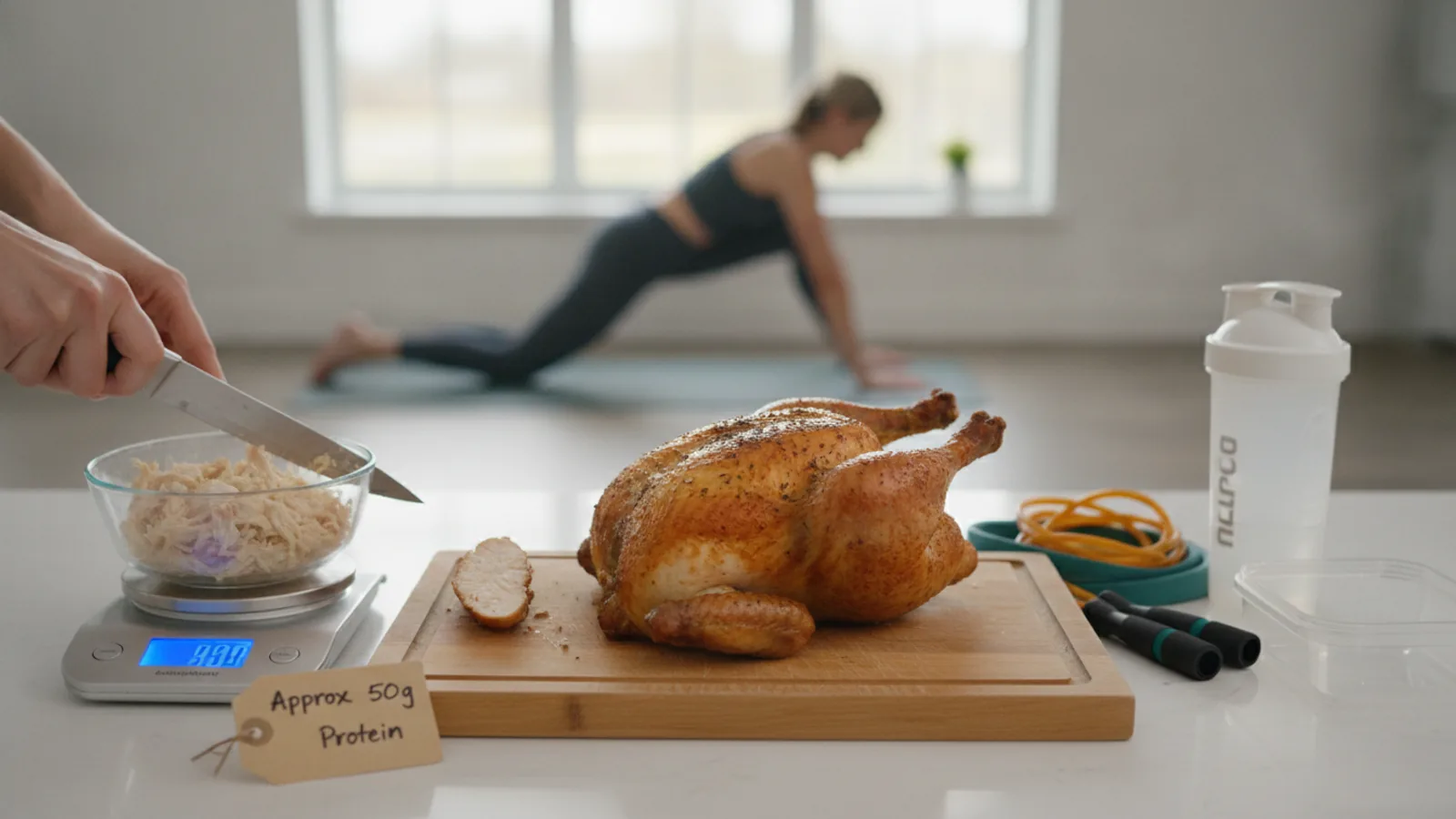
Place the rested chicken on a large cutting board. The goal is to separate it into four distinct groups: white meat, dark meat, skin, and the carcass (bones). Here's a simple method:
- Legs and Thighs (Dark Meat): Pull a leg away from the body and slice through the skin and joint connecting it to the breast. Repeat on the other side. You can separate the drumstick and thigh if you wish. Place this meat in your "dark meat" bowl.
- Wings: Pull the wings away and cut through the joint. Wings have less meat, but you can add it to your dark meat pile or save them for a snack.
- Breasts (White Meat): Find the breastbone running down the center of the chicken. Make a long slice down one side of the bone, from front to back, angling your knife to stay close to the rib cage. The breast meat should peel away in one large piece. Repeat on the other side and place the breast meat in your "white meat" bowl.
- Skin and Bones: Peel off all the skin and place it in a separate pile. The remaining carcass goes into your bone pile. You can now easily pick off any remaining scraps of meat and add them to the correct bowls.
Weigh the Edible Meat Portions
This is the most critical step for an accurate protein count when you don't have a label. Place an empty bowl on your digital food scale and press the "tare" or "zero" button to zero it out.
First, add all the white meat (breast) to the bowl and record its weight in grams or ounces. Zero the scale again, and repeat the process for the dark meat (thighs, legs). Keeping them separate is important because they have different protein densities.
An average 2-pound store-bought rotisserie chicken typically yields about 10-12 ounces of white meat and 8-10 ounces of dark meat once the bones and skin are removed.
Calculate Protein Content Using Standard Values
Now that you have the weight of your meat, you can calculate the total protein. Use these reliable, evidence-based averages derived from USDA food composition data for cooked, skinless chicken:
- White Meat (Breast): Contains approximately 31 grams of protein per 100 grams of meat. This is equivalent to about 8.8 grams of protein per ounce.
- Dark Meat (Thigh/Leg): Contains approximately 26 grams of protein per 100 grams of meat. This is equivalent to about 7.4 grams of protein per ounce.
Example Calculation:
Let's say you measured 12 ounces of white meat and 9 ounces of dark meat.
- White Meat Protein: 12 oz × 8.8 g/oz = 105.6 grams of protein
- Dark Meat Protein: 9 oz × 7.4 g/oz = 66.6 grams of protein
- Total Protein: 105.6 + 66.6 = 172.2 grams of protein in the entire chicken.
Adjust for Skin and Final Portioning
If you plan to eat the skin, remember that it is primarily fat. While it contains some protein (from collagen), eating it will significantly increase the fat and calorie content of your meal and slightly decrease the overall protein percentage by weight. For the most accurate fitness tracking, it's best to track the meat and skin separately or simply discard the skin to get the leanest protein possible.
Once you know the total protein in your chicken, you can divide the meat into meal prep containers based on your personal protein targets. For example, if you need 40 grams of protein per meal, you could portion out about 4.5 ounces of breast meat (4.5 x 8.8 = 39.6g) for each serving.
Quick Reference
| Situation | Use This Part | Why |
|---|---|---|
| Max Protein, Min Fat | Breast meat only, skin removed | Offers the highest concentration of protein with the lowest amount of fat and calories. Ideal for strict cutting phases. |
| Balanced Flavor and Nutrients | A mix of white and dark meat, skin removed | Dark meat provides more iron, zinc, and flavor, complementing the lean protein of the breast for a more well-rounded meal. |
| Forgetting the "Whole Picture" | Check the nutrition label for sodium | Focusing only on protein is a common mistake. The high sodium in rotisserie chicken can cause water retention and impact cardiovascular health. |
| Using the Leftovers | The carcass and bones | Don't discard the frame. Simmering the bones for a few hours creates a nutrient-dense bone broth rich in collagen. |
Common Problems When Calculating Rotisserie Chicken Protein
Even with a clear process, a few common issues can trip you up. Here’s how to solve them.
- Problem: There's no nutrition label on the packaging.
Solution: This is why a food scale is your most important tool. Follow steps 3-5 of this guide meticulously. Carving the chicken, separating the meat, weighing it, and using the standard protein-per-ounce values is the most reliable method when official data isn't available. - Problem: Inaccurate portioning from "guesstimating."
Solution: A 3-ounce serving of chicken is surprisingly small—about the size of a deck of cards. Eyeballing it almost always leads to over- or under-estimating your intake. Always use a digital food scale for measuring your portions until you are extremely experienced at visual estimation. This is non-negotiable for accurate macro tracking. - Problem: Assuming all rotisserie chickens are the same.
Solution: They vary significantly. A Costco chicken is often much larger than one from a smaller local grocery store. Brands also use different brining solutions and rubs, which affects the sodium and final cooked weight. Treat each chicken as a new calculation unless you consistently buy the exact same product. - Problem: The chicken is dry and hard to carve.
Solution: Sometimes, a chicken has been sitting under a heat lamp for too long. If the meat is dry, shred it instead of slicing it. Shredded rotisserie chicken is perfect for tacos, soups, salads, or mixing with a sauce, which will add the moisture back in.
Advanced Tips for Rotisserie Chicken
Ready to take your rotisserie chicken game to the next level? Here are a few pro tips for health and meal prep.
- Make "Protein Pucks" for Quick Meal Prep. After shredding and weighing all the meat, portion it out into individual servings (e.g., 4-ounce portions) and press them firmly into a muffin tin. Freeze the tin for a few hours. Once solid, you can pop out the "pucks" and store them in a freezer bag. This gives you perfectly portioned protein you can grab and thaw anytime.
- Perform a Quick Rinse to Reduce Sodium. While this won't remove the salt from the brine inside the meat, giving the whole chicken a very quick rinse under cold running water before carving can wash away a significant amount of the excess salt from the seasoned skin and surface. Be sure to pat the chicken completely dry with paper towels afterward to avoid a soggy texture.
- Create a Flavor-Infused Broth. When you make bone broth from the carcass, add the skin into the pot as well. The fat from the skin will render out and rise to the top, where it can be easily skimmed off later, but it will add a tremendous amount of roasted flavor to the final broth.
How Much Protein In A Rotisserie Chicken FAQ
How much protein is in a Costco rotisserie chicken?
Costco chickens are known for their large size, typically weighing around 3 pounds (48 ounces) cooked. After removing the bones, skin, and cartilage, you can expect a yield of about 2 pounds (32 ounces) of edible meat. Based on a typical mix of white and dark meat, a whole Costco rotisserie chicken contains approximately 220-250 grams of total protein. A standard 3-ounce serving will provide about 25 grams of protein.
Is rotisserie chicken a healthy choice?
It can be. On the positive side, it's a fantastic source of lean, complete protein, which is vital for muscle health and satiety. However, the high sodium content from the brining and seasoning process is a significant drawback for heart health and can cause bloating. To make it healthier, always remove the skin (where much of the seasoning and fat resides) and balance your intake with plenty of fresh vegetables and low-sodium foods throughout the day.
Does removing the skin also remove protein?
Not in any meaningful way. Chicken skin is composed mostly of fat, with a small amount of collagen (a type of protein). Removing it gets rid of a large number of calories and fat while leaving the protein-dense muscle tissue underneath intact. You lose very little protein but cut out a significant amount of fat, making it a much leaner option.
How many servings are in one rotisserie chicken?
This depends entirely on your protein needs. An average 2-pound chicken yields about 20 ounces of meat, containing roughly 170 grams of protein. For a person aiming for 30-40 grams of protein per meal, this would provide about 4 to 5 servings. For a larger athlete with higher protein needs, it might only be 2 to 3 servings.
Does reheating rotisserie chicken affect the protein?
No, the protein content remains stable during reheating. The main risk with reheating is drying out the meat, which can make it tough and less appealing. To reheat properly, place the chicken in an oven-safe dish with a tablespoon of water or chicken broth, cover it with foil, and warm it in the oven at a low temperature (around 300°F or 150°C) until heated through.
Final Checklist for Rotisserie Chicken Protein
- Check the Label First: Always look for a nutrition facts panel on the packaging for the most accurate data.
- Use a Food Scale: Never guesstimate. Weigh your portions of edible meat for precise tracking.
- Separate Meat Types: Weigh white and dark meat separately for the most accurate calculation, as their protein densities differ.
- Remove the Skin: For the leanest protein source and to reduce fat and sodium, discard the skin.
- Mind the Sodium: Always be aware that rotisserie chicken is a high-sodium food and factor it into your daily dietary goals.
- Store Properly: Keep leftover meat in an airtight container in the refrigerator and consume within 3-4 days for optimal safety and freshness.