How Much Protein In An Spinach
A practical step-by-step guide to how much protein in an spinach, including preparation, instructions, common issues, tips, and next steps.
How Much Protein Is In Spinach?
Spinach contains a surprising amount of protein for a leafy green, but understanding the exact amount requires knowing the difference between its raw and cooked states. This guide helps you accurately calculate the protein in your spinach servings, whether you're adding it to a salad or cooking it into a meal. We'll walk through why weight is more important than volume, how cooking concentrates nutrients, and how to fit this vegetable into your fitness goals realistically.
Fast Answer
- Protein (100g Cooked): ~2.9 grams
- Protein (100g Raw): ~2.86 grams
- Key Difference: Cooking removes water, so 100g of cooked spinach is a much larger portion of the plant than 100g of raw, leafy spinach.
Before You Start Calculating Spinach Protein
- A digital food scale: This is essential for accuracy. Measuring cups are not reliable for leafy greens.
- A nutrition tracking app or website: Using a tool like the USDA FoodData Central database, Cronometer, or MyFitnessPal makes logging easy.
- Your spinach: Whether it's fresh, frozen, raw, or ready to be cooked.
Step-by-Step Instructions to Calculate Spinach Protein
Step 1: Understand the Raw vs. Cooked Difference
This is the most critical step. Spinach is about 91% water. When you cook it, this water evaporates and drains away, drastically shrinking the volume. Because of this, 100 grams of cooked spinach is a much larger quantity of actual spinach leaves than 100 grams of raw spinach.
Imagine a huge salad bowl overflowing with 300 grams of raw spinach. After you sauté it, you might be left with just a small, dense mound weighing 100 grams. The protein from all 300g of raw spinach is now concentrated in that 100g cooked portion. This is why you must know whether the nutrition data you're looking at is for "raw" or "cooked" spinach.
Step 2: Weigh Your Spinach Using a Food Scale
Do not use measuring cups. A "cup" of raw spinach can be loosely packed or tightly crammed, resulting in a weight difference of 200% or more. Weight is the only accurate measurement.
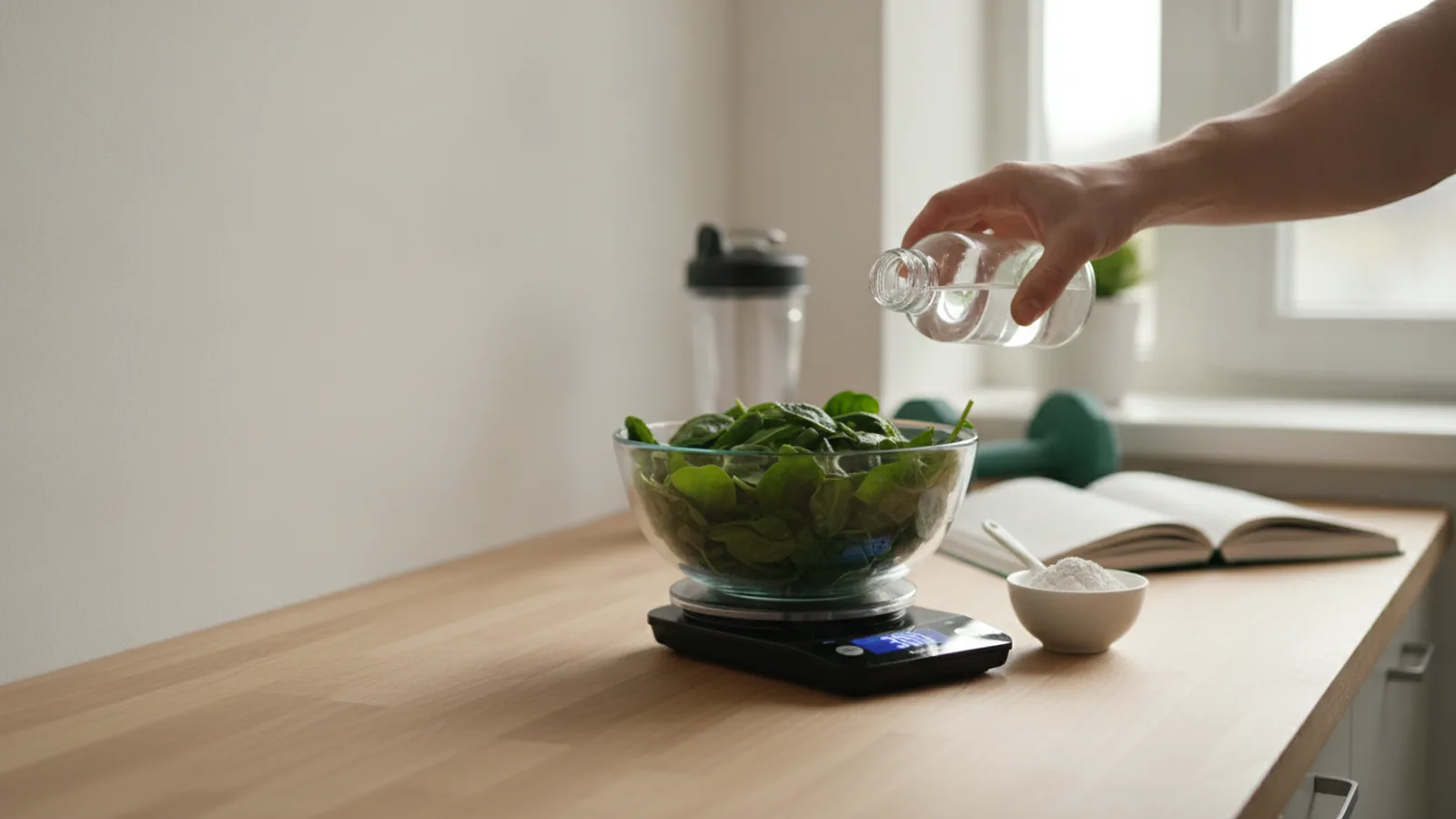
Place a bowl on your digital food scale and press the "tare" or "zero" button. This subtracts the bowl's weight. Now, add your spinach to the bowl to get its precise weight in grams. Decide if you will weigh it raw (before cooking) or cooked (after cooking) for the most accurate tracking.
Step 3: Calculate Protein for Raw Spinach
Raw spinach is perfect for salads and smoothies. The standard nutritional value for raw spinach is approximately 2.86 grams of protein per 100 grams (about 3.5 ounces).
Let's use an example. If you prepare a salad and add a large handful of raw spinach that weighs 50 grams on your scale, the calculation would be:
(50g / 100g) * 2.86g protein = 1.43 grams of protein.
As you can see, the protein contribution from a typical raw serving is quite small. It adds up with other ingredients, but it's more of a nutritional bonus than a protein powerhouse in this form.
Step 4: Calculate Protein for Cooked Spinach
When you cook spinach, the nutrients become more concentrated relative to the final weight. The standard value for cooked, boiled, and drained spinach is approximately 2.9 grams of protein per 100 grams.
Let's say you sautéed a large bag of spinach for your meal prep. You place a portion on your scale and it weighs 150 grams. The calculation is:
(150g / 100g) * 2.9g protein = 4.35 grams of protein.
You can eat a much larger amount of protein from cooked spinach simply because the volume is so much smaller, making it easier to consume a serving size of 100g or more.
Step 5: Log the Value in Your Nutrition Tracker
Open your preferred nutrition tracking app. Use the search function and be very specific. Search for "Spinach, raw" or "Spinach, cooked, boiled, drained" to find the correct entry in the database. Most apps use data from sources like the USDA.
Once you select the correct food item, the app will prompt you to enter the serving size. Choose the unit as "grams" and enter the weight you measured on your scale. The app will then automatically calculate and add the protein, carbs, fats, and micronutrients to your daily total.
Common Problems When Tracking Spinach Protein
Mistake 1: Confusing Volume (Cups) with Weight (Grams)
The biggest error people make is estimating with measuring cups. Leafy greens are not uniform. A tightly packed cup of spinach can weigh 50 grams, while a loosely filled one might only be 20 grams. This throws off your protein calculation significantly. Always use a digital food scale. Weight is an absolute measure; volume is a highly variable estimate.
Mistake 2: Using Raw Data for Cooked Spinach (or Vice Versa)
If you weigh 100g of raw spinach, log it as "100g raw spinach" (2.86g protein). If you cook that same 100g of raw spinach, it might only weigh 30g once cooked. If you then log "100g cooked spinach" you would be incorrectly crediting yourself with nearly 3g of protein when you only consumed about 0.9g. Be consistent: measure the food in its final state and log that specific state.
Mistake 3: Forgetting About Added Ingredients
Spinach is rarely eaten alone. Creamed spinach, spinach salads with dressing and cheese, or spinach sautéed in butter all contain additional ingredients that contribute protein, fat, and calories. For an accurate count, you must weigh and log every component: the oil, the cheese, the cream, and the spinach itself.
Mistake 4: Relying on Spinach as a Main Protein Source
To get 20 grams of protein, a common amount for a post-workout meal, you would need to eat nearly 700 grams (about 1.5 pounds) of cooked spinach. This is an enormous and impractical amount. View spinach as a "protein-assist" food. It adds a gram or two here and there, but its main value comes from fiber, vitamins (like K, A, and C), and minerals (like iron and manganese).
Advanced Tips for Spinach in Your Diet
Tip 1: Create a Complete Protein
Like most plant-based sources, spinach protein is "incomplete," meaning it doesn't contain high enough levels of all nine essential amino acids our bodies can't produce. This is easily solved by pairing it with other foods. Combining spinach with eggs, dairy (like feta or parmesan cheese), quinoa, or whole grains creates a meal with a complete amino acid profile, making the protein more useful for muscle repair and growth.
Tip 2: Enhance Iron Absorption
Spinach is famous for its iron content. However, the type of iron in plants (non-heme iron) is not as easily absorbed by the body as the iron from meat. You can significantly boost absorption by consuming spinach with a source of Vitamin C. Squeeze fresh lemon juice over your cooked spinach, or add vitamin-C-rich foods like bell peppers or tomatoes to your spinach salad.
Tip 3: Manage Oxalates by Cooking
Raw spinach is high in compounds called oxalates, which can bind to minerals like calcium and iron, making them harder for your body to absorb. For most people, this is not a major concern. However, if you are prone to kidney stones or have mineral absorption issues, cooking your spinach is a great strategy. The cooking process significantly reduces the oxalate content, making the minerals more bioavailable.
How Much Protein In Spinach FAQ
Is spinach a good source of protein?
It's a good source of protein for a leafy green vegetable. Compared to foods like chicken, beef, fish, lentils, or tofu, its protein content is very low. It's best viewed as a nutrient-dense vegetable that provides a small, helpful protein boost to a meal.
Does frozen spinach have the same amount of protein?
Yes, the protein content is virtually identical. Frozen spinach is typically blanched (cooked briefly) before freezing. The key is to measure it accurately. For best results, thaw the spinach and squeeze out as much excess water as possible before weighing it. Then, log it as "cooked spinach."
Which has more protein: spinach or kale?
They are very close. Per 100 grams cooked, kale has slightly more protein, at around 3.3 grams compared to spinach's 2.9 grams. In the context of a varied diet, this difference is too small to matter. You should choose the one you enjoy eating more.
How much spinach would I need for 10 grams of protein?
You would need to eat approximately 345 grams of cooked spinach (about 12 ounces). This demonstrates why spinach should be paired with a primary protein source to meet your daily fitness and health goals.
Quick Reference
| Situation | Measure This | Why |
|---|---|---|
| Making a quick salad | Raw spinach by weight (grams) | Easiest way to track a small, uncooked portion. Preserves water-soluble vitamins. |
| Adding to eggs or a stir-fry | Cooked spinach by weight (grams) | Cooking massively reduces volume, allowing you to eat more and get more concentrated nutrients. |
| Blending a smoothie | A handful of raw or frozen | In a smoothie, the primary goal is vitamins and fiber. The protein is a small bonus, and precise measurement is less critical. |
| Trying to meet high protein goals | Spinach + a primary protein source | Pair spinach with chicken, eggs, tofu, or beans. Spinach alone is not efficient for building high-protein meals. |
Final Checklist for Tracking Spinach Protein
- Did you decide if you are measuring your spinach raw or cooked?
- Did you use a digital food scale to measure the weight in grams?
- Did you avoid using inaccurate volume measurements like cups?
- Did you find the correct entry ("raw" or "cooked") in your nutrition tracking app?
- Did you remember to log any oils, cheeses, or dressings used with the spinach?
- Did you frame spinach as a nutrient-dense vegetable with a protein bonus, not a main source?