How Many Exercises Per Workout
A practical step-by-step guide to how many exercises per workout, including preparation, instructions, common issues, tips, and next steps.
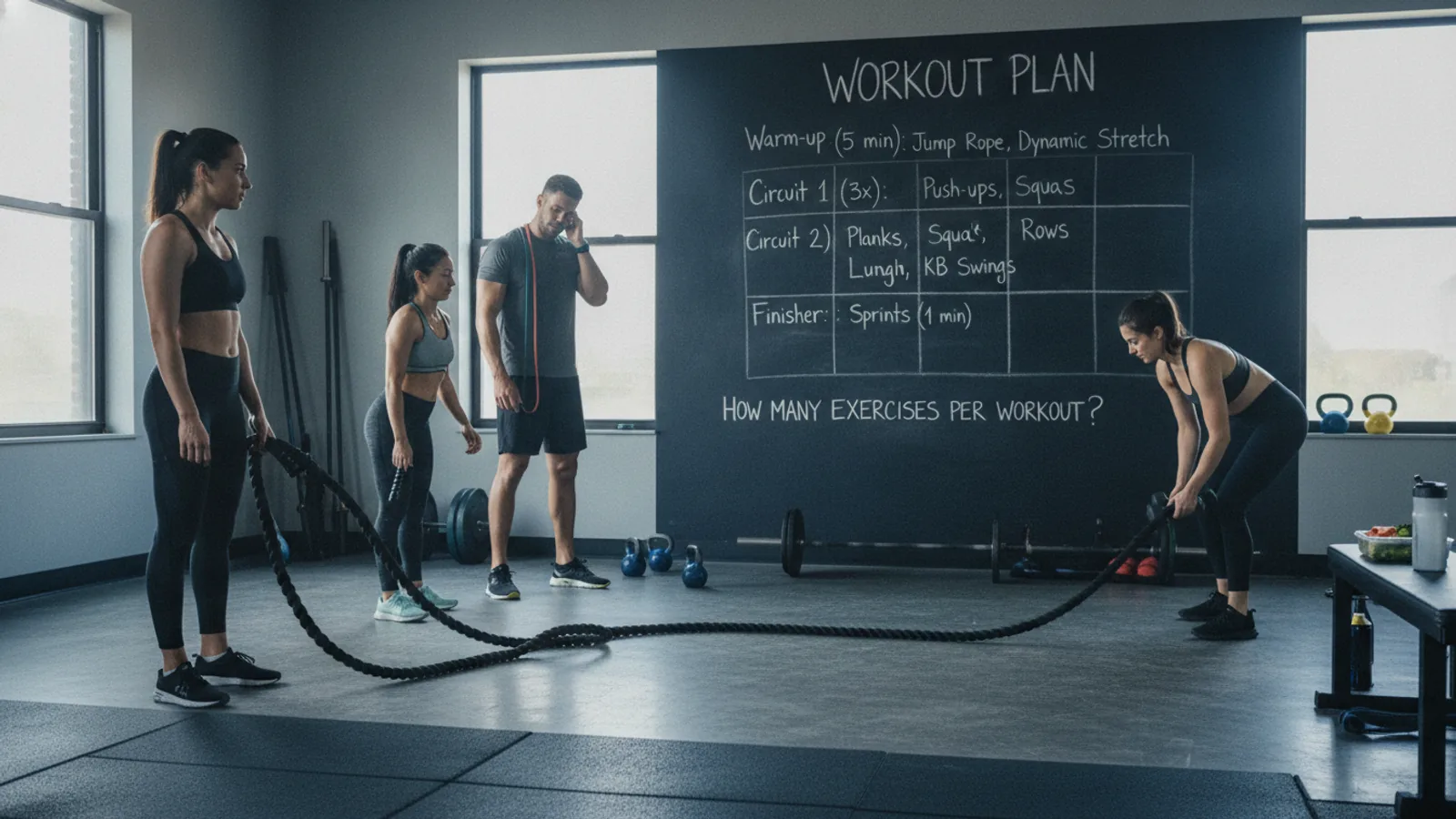
How Many Exercises Per Workout
Figuring out the ideal number of exercises for your workout can feel confusing, but it's the key to getting results without wasting time or risking injury. The right number depends entirely on your goal, experience level, and how much time you have. This guide provides clear, practical steps to help you determine the perfect amount of exercises to build strength, grow muscle, or improve your overall fitness, ensuring every minute in the gym is effective.
Fast Answer
- For Strength: 3-5 compound exercises
- For Muscle Growth: 5-8 exercises (compound & isolation)
- For Full Body: 4-8 exercises (covering major muscle groups)
- For Endurance: 6-10+ exercises (often in a circuit)
Before You Start
- A clear fitness goal: Know whether you're training for strength, muscle size, endurance, or general health.
- Your current fitness level: Be honest about whether you are a beginner, intermediate, or advanced lifter.
- A realistic weekly schedule: Determine how many days per week you can consistently commit to training.
- Access to equipment: Know what tools you have available, whether it's a full gym, dumbbells at home, or just your body weight.
Step-by-Step Instructions
Define Your Primary Fitness Goal
Before you pick a single exercise, you must know what you're trying to achieve. Your goal is the single most important factor that dictates how many exercises you should do. Different goals require different stimuli and training volumes.
- Strength: The goal is to lift the heaviest weight possible for a few repetitions. This requires focusing your energy on a small number of big, heavy lifts.
- Hypertrophy (Muscle Growth): The goal is to increase the physical size of your muscles. This requires more variety and volume to stimulate the muscle fibers from different angles.
- Muscular Endurance: The goal is to perform an exercise for many repetitions or for a long duration. This often involves more exercises with less rest.
- General Fitness: A balanced approach aiming for a bit of everything: strength, heart health, and mobility.
Write down your main objective. For example, "My primary goal is to build muscle in my upper body." This clarity will guide every other decision.
Determine Your Training Split
Your training "split" is how you organize your workouts throughout the week. This directly influences how many exercises you do in a single session. If you work your entire body in one workout, you'll need exercises for every major muscle group. If you focus on just one or two muscle groups, you'll do more exercises for those specific areas.
Common splits include:
- Full Body: You train all major muscle groups in each session, typically 3 times per week. This is excellent for beginners.
- Upper/Lower Split: You train your upper body one day and your lower body the next, usually working out 4 times per week.
- Push/Pull/Legs (PPL): You group exercises by movement pattern. "Push" day (chest, shoulders, triceps), "Pull" day (back, biceps), and "Legs" day. This is a popular intermediate split.
- Body Part Split: You dedicate each workout to one or two muscle groups (e.g., Chest Day, Back Day). This is common among advanced bodybuilders.
Select 2-4 Core Compound Exercises
No matter your goal, your workout should be built around compound exercises. These are multi-joint movements that work several muscle groups at once, giving you the most bang for your buck. They are highly effective for building strength and overall muscle mass.
Your core lifts should align with your training split for the day. For example:
- Full Body Day: Barbell Squat (legs), Dumbbell Bench Press (chest/shoulders), Pull-Ups (back), and a Plank (core).
- Lower Body Day: Deadlift (hamstrings/glutes), Leg Press (quads), and Bulgarian Split Squats (unilateral strength).
- Push Day: Barbell Bench Press (chest), Overhead Press (shoulders), and Dips (triceps/chest).
Choose 2 to 4 of these foundational movements to start your workout. These are the exercises where you should focus on lifting progressively heavier weight over time.
Add 2-4 Accessory or Isolation Exercises
After your main compound lifts, you can add accessory (or isolation) exercises. These movements target a single joint and muscle group. They are crucial for addressing weaknesses, adding training volume for muscle growth, and preventing injury by strengthening stabilizer muscles.
The number of accessory exercises you add depends on your goal:
- For Strength: You might only add 1-2 accessory exercises to support your main lifts. For example, after heavy bench presses, you could add tricep pushdowns to strengthen your triceps for a stronger lockout.
- For Hypertrophy: You will likely add 2-4 accessory exercises to increase volume and hit the muscle from different angles. After squats and leg presses, you might add leg extensions (quads), hamstring curls, and calf raises.
Your total number of exercises per workout is simply your compound lifts plus your accessory exercises. For most people, this will land somewhere between 4 and 8 exercises in total.
Plan Your Sets and Reps to Manage Volume
The number of exercises is only one part of the equation. Total training volume—calculated as sets x reps x weight—is what truly drives results. You need to balance the number of exercises with the number of sets you perform for each.
There's an inverse relationship: if you do more exercises, you should generally do fewer sets for each one to keep the workout from becoming too long and fatiguing. If you do fewer exercises, you can perform more sets for each.
- General Guideline: Aim for a total of 10-20 hard sets per muscle group per week for muscle growth. You can distribute these sets across your workouts.
- Example: For a chest workout, you could do 4 sets of Bench Press, 3 sets of Incline Dumbbell Press, and 3 sets of Cable Flyes. That’s 3 exercises and a total of 10 sets for the chest in that session.
Monitor Your Workout Duration
A productive workout doesn't need to last for hours. In fact, after a certain point, performance declines, stress hormones rise, and you start accumulating "junk volume"—reps that cause fatigue without contributing to results. The number of exercises you choose should fit within a reasonable timeframe.
- Ideal Range: For most people, a weight training session should last between 45 and 75 minutes, not including warm-up and cool-down.
- Beginners: A 45-minute workout is often plenty.
- Advanced Lifters: May train for up to 90 minutes, but this requires careful nutrition and recovery management.
If your planned workout is taking over 90 minutes, you are likely doing too many exercises, too many sets, or resting for too long between sets. Consider cutting an exercise or using time-saving techniques like supersets.
Listen to Your Body and Adjust Over Time
The perfect number of exercises is not set in stone. It's a moving target that depends on your recovery, nutrition, stress levels, and sleep. The key is to pay attention to feedback from your body.
- Signs you're doing too much (overtraining): Persistent soreness that doesn't go away, stalled progress or getting weaker, chronic fatigue, poor sleep, and nagging injuries. If you experience these, consider reducing the number of exercises or taking an extra rest day.
- Signs you're doing too little: You're never sore, you feel you could easily do another workout right after finishing, and you aren't seeing progress in strength or size after several weeks. In this case, you can try adding one more accessory exercise or increasing your sets.
Track your workouts in a journal or app. Note the exercises, sets, reps, and weight. Also, jot down how you felt. This data will empower you to make intelligent adjustments to your program based on real results, not just guesswork.
Quick Reference
| Situation | Exercises Per Workout | Why |
|---|---|---|
| I'm a beginner doing full-body workouts. | 4-6 exercises | Covers all major muscle groups to build a strong foundation without being overwhelming. |
| My goal is maximum strength. | 3-5 heavy compound exercises | Focuses all your energy on moving the most weight for key lifts, which is the primary driver of strength. |
| I want to build muscle (hypertrophy). | 5-8 exercises (mix of compound & isolation) | Provides enough volume and variety to stimulate muscle growth from multiple angles. |
| I'm short on time (30-45 minutes). | 3-5 compound exercises | Maximizes efficiency by working multiple muscles at once, delivering a great workout in less time. |
| I'm an advanced lifter on a body-part split. | 6-8 exercises per muscle group | Allows for high volume focused on a specific area to push past plateaus and refine muscle development. |
Common Problems When Planning Your Workout
Problem: Doing Too Much (Junk Volume)
Many people fall into the trap of thinking "more is better." They pack their workouts with 10-15 different exercises, thinking it will lead to faster results. In reality, this often leads to junk volume—doing work that just adds fatigue without stimulating more growth. Your muscles have a finite capacity to recover and adapt. Once you've stimulated them enough, any extra work just digs into your recovery ability.
The Fix: Focus on quality over quantity. Prioritize progressive overload (getting stronger over time) on a handful of key exercises. If you find yourself unable to recover between sessions or your strength is stalling, try cutting one or two of your least important accessory exercises and see if your performance on the main lifts improves.
Problem: Poor Exercise Selection and Redundancy
Doing a lot of exercises doesn't help if they all do the same thing. A workout with a flat barbell press, incline barbell press, flat dumbbell press, and machine chest press is largely redundant. You're hitting the chest from very similar angles and neglecting other important muscles, like your back or legs.
The Fix: Build your workout around fundamental movement patterns. A balanced workout should include: a squat variation, a hinge variation (like a deadlift), a horizontal push (like a bench press), a horizontal pull (like a row), a vertical push (like an overhead press), and a vertical pull (like a pull-up). This ensures you're training your body in a balanced way.
Problem: Not Enough Intensity
Sometimes the issue isn't the number of exercises, but the effort put into them. If you can breeze through 8 exercises without breaking a sweat or feeling challenged on your last few reps, you may not be training hard enough. Your muscles need to be challenged to grow.
The Fix: For each exercise, focus on training close to muscular failure on your working sets. This means the last 1-2 reps should be very difficult to complete with good form. If you finish a set feeling like you could have done 5 more reps, the weight is too light. Increasing intensity will often make a 5-exercise workout feel more effective than a lazy 10-exercise one.
Advanced Tips for Structuring Your Workouts
Use Supersets to Increase Density
A superset is when you perform two different exercises back-to-back with little to no rest in between. This is an excellent technique to get more work done in less time, allowing you to fit more exercises into your session without it lasting for hours. The most effective way is to pair exercises for opposing muscle groups (antagonistic supersets), such as a bench press (chest) followed immediately by a barbell row (back). This allows one muscle group to rest while the other works.
Track Total Weekly Sets Per Muscle Group
Instead of just thinking about exercises per workout, advanced trainees often track their total number of hard sets per muscle group per week. Research suggests that for most people, 10-20 weekly sets per muscle group is the "sweet spot" for muscle growth. This gives you flexibility. You could hit 12 sets for your chest in one workout, or you could do 6 sets in a workout on Monday and another 6 sets on Thursday. This metric-driven approach allows for more precise control over your training volume.
Implement Periodization
Periodization is the planned variation of your training variables over time. You might not do the same number of exercises all year round. You could have a 4-week "accumulation" phase where you use a higher number of exercises (e.g., 7-8 per workout) to build volume and work capacity. This could be followed by a 4-week "intensification" phase where you drop the exercise count to 3-4 per workout but focus on lifting much heavier weight to build maximal strength. This cycling prevents plateaus and reduces the risk of overuse injuries.
How Many Exercises Per Workout FAQ
How many exercises should I do for a full-body workout?
A great range for a full-body workout is 4 to 8 exercises. The goal is to hit every major muscle group efficiently. A simple and effective template is to pick one exercise for each primary movement pattern: a squat (quads/glutes), a hinge (hamstrings/glutes), a push (chest/shoulders), a pull (back/biceps), and a core exercise.
Is it better to do more exercises or more sets?
This depends on your goal. For pure strength, it's often better to do fewer exercises with more sets (e.g., 5 sets of 5 reps on squats) to master the lift. For muscle growth, a balance is best. The most critical factor is your total weekly volume. Both strategies can work as long as you are progressively overloading and training with sufficient intensity.
How many exercises should a beginner do?
A beginner should start with 3 to 5 compound exercises per session in a full-body routine. This is enough to stimulate growth and build a strong foundation without being overwhelming. The focus should be on learning perfect form on fundamental lifts like squats, deadlifts, bench presses, and rows before adding a lot of isolation work.
How many exercises should I do per muscle group in a single workout?
For large muscle groups like legs, back, and chest, aiming for 2 to 4 exercises is a solid guideline. For smaller muscle groups like biceps, triceps, and calves, 1 to 2 exercises is usually sufficient, as they already get a lot of indirect work from your big compound lifts.
Final Checklist for Planning Your Workout
- My primary fitness goal (strength, hypertrophy, etc.) is clearly defined.
- I have chosen a training split that fits my weekly schedule.
- My workout is built around 2-4 core compound exercises.
- I have added 1-4 accessory exercises that support my goal and address weak points.
- My total planned exercise count is between 4 and 8 for most workouts.
- The entire session, including warm-ups, can be completed in 45-90 minutes.
- I have a plan to track my progress (weight lifted, reps, sets) over time.
- I am prioritizing sleep and nutrition to ensure I can recover from my training.